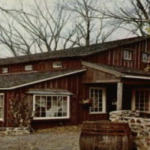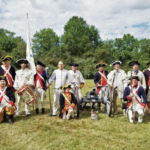
In 1969, the story turned again — from farmland and artists’ colony to a destination for craft and community. The Chadds Ford Barn Shops opened as a village of historic buildings given new life: traditional Pennsylvania bank barns, chicken coops, and outbuildings, once the backbone of local agriculture converted into studios and storefronts for artisans, …

Part 6 - The Land Reborn
NALT & the Brandywine Project

What makes this chapter distinctly of the twenty-first century is a return to the land itself — and it is happening right now, next door. The same ground that anchored Washington’s defensive line and inspired N. C. Wyeth’s brush is being cultivated anew, not for war or industry, but for restoration, education, and shared public life.
Programming at the Barn Shops extends naturally into this landscape, anchoring a healthy rhythm of outdoor time and land stewardship.
A Landmark Preservation, Finalized in 2025
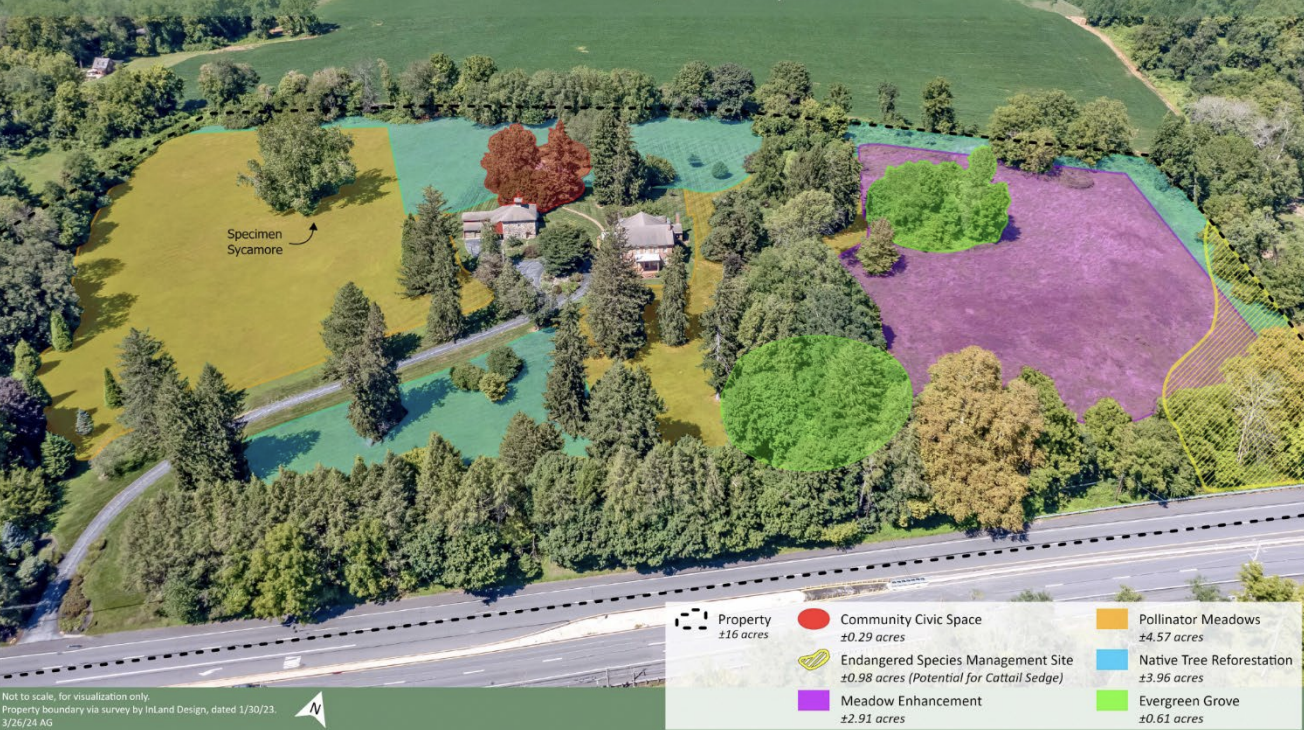
Immediately beside the Barn Shops lies the Joseph Davis Tract — a NALT-protected, 16-acre historic property at 1597 Baltimore Pike that once formed the center of the Continental Army’s main line and later served as N.C. Wyeth’s home and studio. In early 2025, after a years-long campaign, the North American Land Trust (NALT) — a national conservation organization headquartered in Chadds Ford — finalized its acquisition of the Tract. The land is now permanently protected from development, with a conservation easement held by Chadds Ford
Township.
“Protection of the Joseph Davis Tract is a huge achievement for the Brandywine Battlefield and for the battlefield preservation movement more broadly,” said David Duncan, President of the American Battlefield Trust. It is NALT’s second preserved battlefield property in the township, joining the 72-acre Brinton Run Preserve just over a mile away.
A Vision Map for Restoration — and a Wyeth Studio Reborn
NALT’s plans transform the property into an active historic, cultural, and natural-resource attraction. The Vision Map above lays out the restoration: nearly five acres of pollinator meadows, almost four acres of native tree reforestation, meadow enhancement, an evergreen grove, and a dedicated management site for the stateendangered cattail sedge documented on the land. A ±0.63-mile public trail will loop through the rolling fields past the property’s celebrated specimen sycamore, inviting walking, birding, and family outings minutes from the village core.
At the heart of it stands the 1725 Joseph Davis House, which NALT will restore as its new national headquarters and open to the public as interpreted space — including N. C. Wyeth’s former studio. The Brandywine River Museum of Art is a key cultural partner in that interpretation. William L. Coleman, director of the museum’s Wyeth Study Center, called NALT’s plan to make the studio “a publicly accessible, interpreted space… tremendously exciting,” a major addition to the region’s networked natural and cultural resources. The building where Treasure Island was illustrated will, for the first time, be open to those who come to walk the ground.
Walkable Chadds Ford: Connecting Trails to Town
These pieces are being stitched together into a single, walkable village. Through the Township’s Walkable Chadds Ford Trail Project — with trail construction, boardwalks, and landscaping underway in coordination with the Brandywine Conservancy and Museum of Art — the Joseph Davis Tract, the Barn Shops, and the wider Village District will be linked by paths and a park-like village green. The Barn Shops serve as that green’s front porch: the place where preserved battlefield land and restored habitat meet a working town center. Trail access tied to the Tract’s meadow and woodland walks is already among the campus’s signature amenities.
A $100 Million Neighbor: The Brandywine’s Campus Transformation
Directly across Route 1 from the Barn Shops, an even larger transformation is taking shape. In May 2026, the Brandywine Conservancy & Museum of Art — the region’s cultural anchor since 1967, home to the world’s foremost Wyeth collection — announced an approximately $100 million project to reimagine its Chadds Ford campus. It is the most ambitious undertaking in the institution’s nearly 60-year history, and it will unfold quite literally within view of the Barn Shops’ porches.
At its center is a new 40,000-square-foot museum building — the first U.S. commission for the celebrated Tokyo architecture firm Kengo Kuma & Associates, working with Boston’s Schwartz/Silver Architects. Conceived as a series of wood-clad pavilions inspired by Pennsylvania’s bank barns and designed to rise from the landscape rather than dominate it, the new building will nearly double the museum’s exhibition space to almost 20,000 square feet, including a gallery devoted to 130 years of work by five Wyeth family artists across three generations. The beloved 19th-century Mill building will be carefully renovated alongside it.
Just as consequential is the land. Led by Field Operations — the landscape firm behind New York’s High Line — the project will expand the museum’s 15-acre grounds into a 325-acre public preserve and garden with roughly ten miles of trails, boardwalks through wetlands, native plantings, an outdoor classroom, and a nature play 7 area. Those trails will connect the two museum buildings to the nearby N. C. and Andrew Wyeth studios, both National Historic Landmarks. Construction is expected to begin in spring 2027 and open in fall 2029.
For the Barn Shops, this is more than a distinguished neighbor. Together with the Joseph Davis Tract next door and the Walkable Chadds Ford trail network stitching them together, the museum’s expansion completes an emerging cultural and ecological corridor — battlefield, artist’s studio, restored meadow, working village, and world-class museum — all within a short walk along the old Baltimore Pike. The Barn Shops sit squarely at the heart of it: the everyday commons where visitors to all of it gather, linger, and connect. It is a fitting model of stewardship, echoed at every scale.
Part 7 – 2026 Community First Coming Soon